Burt Chapel
Midwinter BreakBurt Chapel is a church in Donegal designed by Liam McCormick and modelled on the nearby Iron Age fort Grianán of Aileach. Its circular form makes the building part of a deliberate conversation between contemporary religious architecture and an ancient landmark. The chapel is also remembered through Gerry’s visit with Stella: while he showed her the project, she turned from the architectural resemblance to the view and the long history it seemed to hold.
Design and Setting
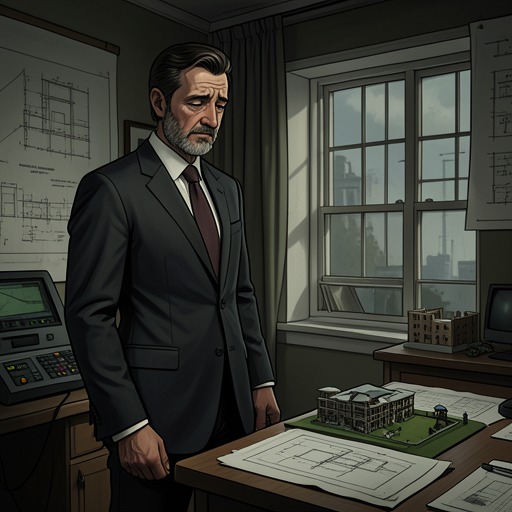
McCormick was working on Burt Chapel when Gerry was taken on by his practice. The chapel’s model was Grianán of Aileach, a circular Iron Age fort higher up the hill; the church stood at the fort’s foot. Their shared shape linked two structures separated not only by distance on the hillside but by thousands of years. The resemblance made the setting itself part of the design’s meaning: the new church could be read against an older form rooted in the same landscape.
The project belonged to a period of change in Catholic church architecture. After the Second Vatican Council, liturgical reforms altered the spaces in which worship took place: priests were to face the congregation, altar rails were to disappear, and older decorative features were to be dismantled. Gerry’s earlier architectural work had included colouring prints to distinguish materials, but the work with McCormick brought him close to a building shaped by those larger changes in religious practice.
Gerry and Stella at the Chapel
Gerry had met Stella in the late 1960s. Not long after their trip to Ballycastle, he took her to Donegal to show her what he was working on. They drove up to Grianán of Aileach to see how it resembled the chapel below. For Gerry, the fort and church offered a striking architectural parallel; Stella was more interested in the panorama.
She observed that, apart from some trees and roads, the view was much as it would have been two thousand years earlier. From the high ground, a slow turn of the head took in Donegal, Derry, and Tyrone, with Lough Swilly and Lough Foyle between them. The chapel’s setting thus opened beyond the comparison of two circular structures: it placed the present-day visit within a landscape Stella experienced as continuous with the ancient past.
Landscape and Narrative Significance
Stella’s response gives the site a meaning distinct from the professional interest with which Gerry brought her there. She felt glad to be Celtic, and the height and breadth of the view made that identification concrete in the counties and waters visible around her. Even the silence was qualified by the wind, which could make the ears seem to register no sound, with perhaps a sheep’s bleat breaking through. Her raised hand testing the wind’s direction remains the scene’s defining gesture, set against the chapel and fort below and behind her.
Burt Chapel consequently stands in the story as both a work of modern church architecture and a meeting point of personal memory, religious change, and deep time. Gerry’s account begins with the building and its ancient architectural counterpart, but Stella’s attention shifts the emphasis to the land: the project he came to show her becomes the occasion for her vision of a Celtic landscape enduring across centuries.